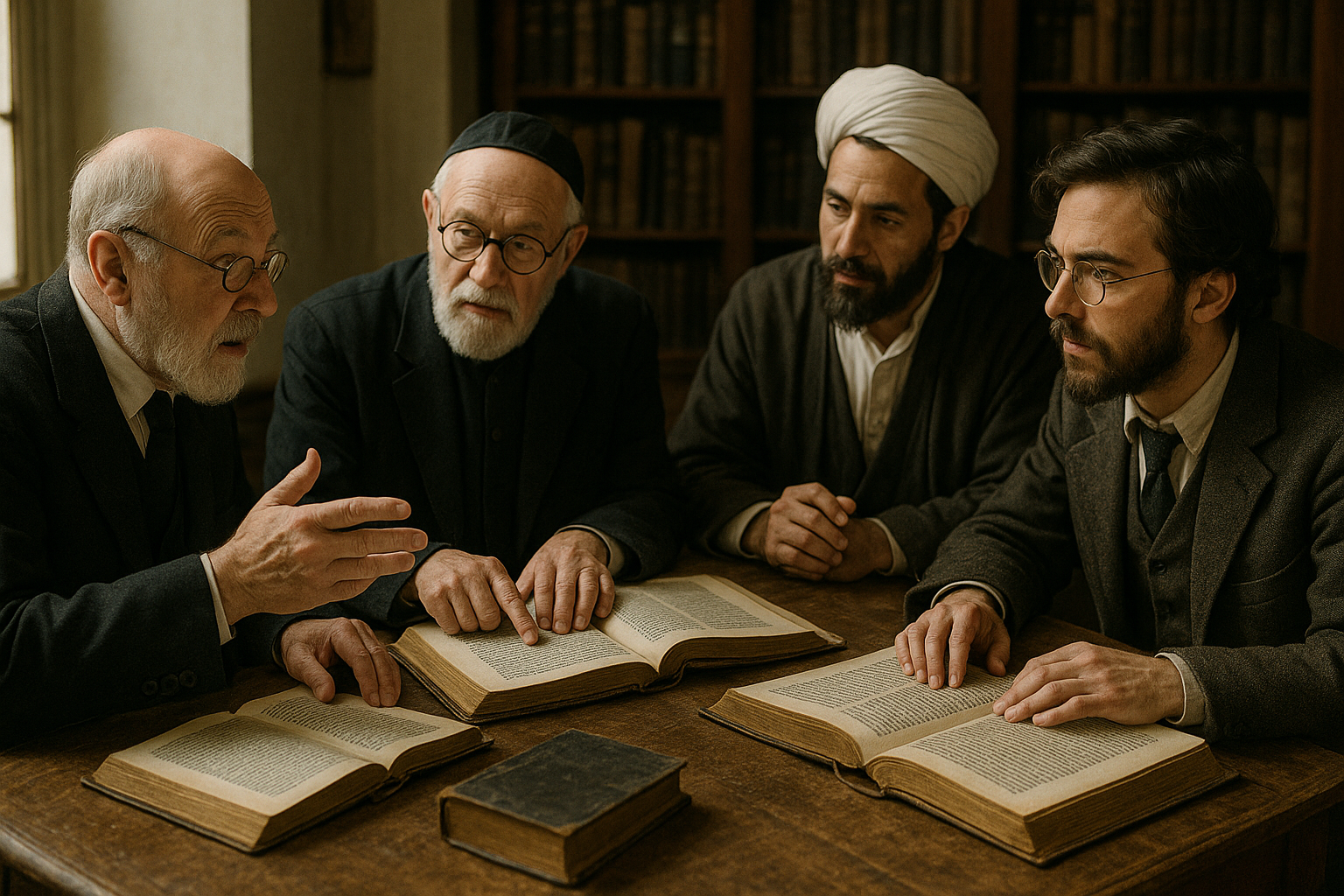
In bustling cities like Cairo, with the call to prayer echoing through the streets, the Qur'an is revered as the unaltered word of God. For many Muslims, this belief challenges the integrity of earlier scriptures, like the Bible. The doctrine of tahrif—claiming the Torah, Psalms, and Gospel have been altered—fuels this skepticism. But what does historical evidence suggest?
The notion of tahrif is more than just a belief; it's been rigorously examined through historical and textual scrutiny. The Qur'an implies changes in earlier texts (Surah Al-Baqarah [2:75]). Scholars like Mohammad Abu Laylah argue that inconsistencies in the Bible necessitate the Qur'an as a corrective. Yet, this view often overlooks significant scholarly findings.
New Testament scholar Bart Ehrman, in "Misquoting Jesus," acknowledges variations in early biblical manuscripts. However, he argues these are typical for ancient texts, not evidence of deliberate corruption. F.F. Bruce, in "The New Testament Documents: Are They Reliable?", emphasizes the extensive manuscript evidence that allows accurate reconstructions of original texts. This robustness is frequently overlooked in criticisms focused on textual variations.
While the Qur'an is praised for its preservation in a single language, this can also be a limitation. The complexity of ancient Arabic can lead to varied interpretations, as scholars like Patricia Crone suggest. These language discrepancies can foster the Qur'an being interpreted at one mosque as peaceful and at another as warring, making it easily manipulated by governments that push specific narratives. Widely shifting interpretations emerge from different areas, locations, and political climates, something rarely recognized or discussed within communities that claim it as the inerrant word.
Before the discovery of the Dead Sea Scrolls, criticisms of the Bible's integrity were rampant. Critics argued that numerous translations indicated inconsistency. Yet, these Scrolls, unearthed in the mid-20th century, provided ancient manuscripts consistent with later versions, proving the Bible's textual integrity.
Concerns about the timing of Gospel writings, completed decades after Jesus's life, raise questions about their accuracy. Skeptics claim these accounts reflect community reflections rather than divine revelations. However, N.T. Wright highlights the strength of oral tradition in Jewish culture, which ensured faithful transmission of teachings even without immediate documentation.
Questions of authorship further fuel criticism. Although debates over who wrote certain texts persist, the consistency of theological themes and early canonical acceptance affirm their credibility. As Richard Bauckham notes, what seem like contradictions between Gospel accounts often reveal diverse theological intentions rather than historical errors.
The Trinity is another debated topic, with Muslims seeing it as a deviation from monotheism. Historical records show that early Christians developed the Trinity to express their understanding of God's nature, with implicit references in the New Testament.
The crucifixion narrative also faces challenges. While Islam typically denies the event as described in the New Testament, historians like John Dominic Crossan point to strong historical evidence from both Christian and non-Christian sources, establishing it as a well-documented event by scholarly standards.
Critiques of moral or theological aspects of biblical narratives often arise from differing views on prophetic infallibility. Islam regards prophets as sinless, while Christianity uses these narratives to explore themes of human fallibility and divine grace.
Despite criticisms, the Bible is scrutinized more intensely than perhaps any other text, not only within religious communities but in respected universities globally. Indeed, if any fallibility in its integrity were to be found, it would be magnified and broadcast widely by those seeking to harm its reputation. Yet, under such intense scrutiny, the Bible constantly reaffirms itself as a text without equal. Its resilience is a testament to its significant impact and ability to inspire dialogue across faiths. Engaging with these criticisms fosters deeper interfaith understanding, uniting believers in a shared journey of faith amid doubt, much like the vibrant diversity of Cairo itself.